
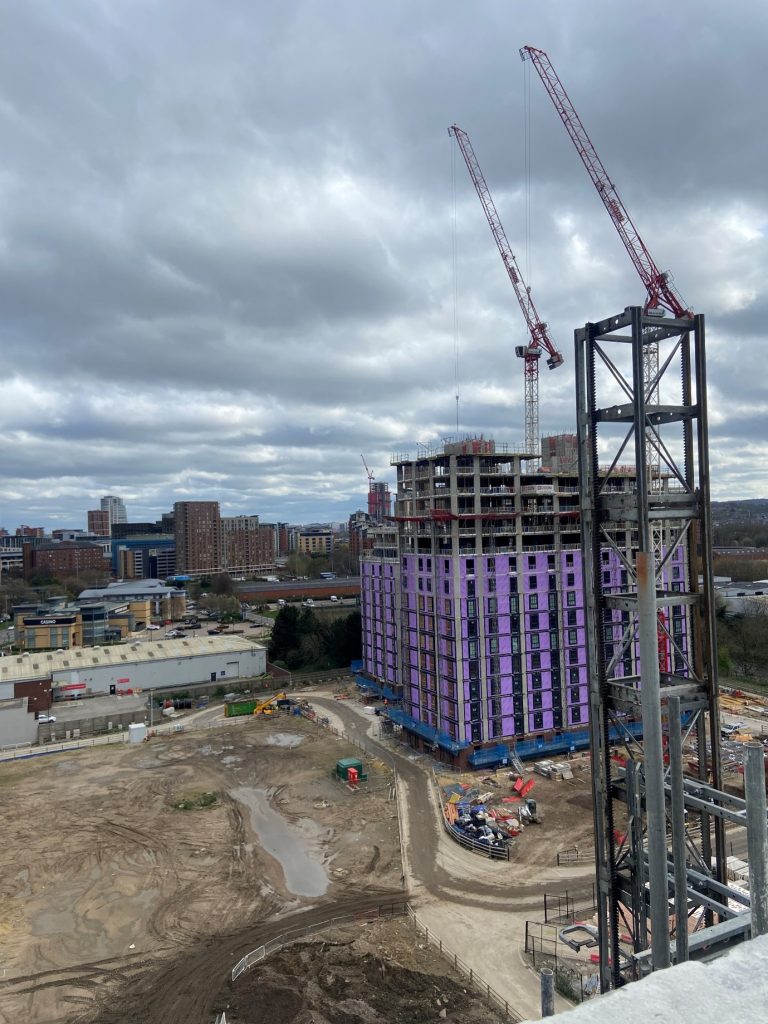
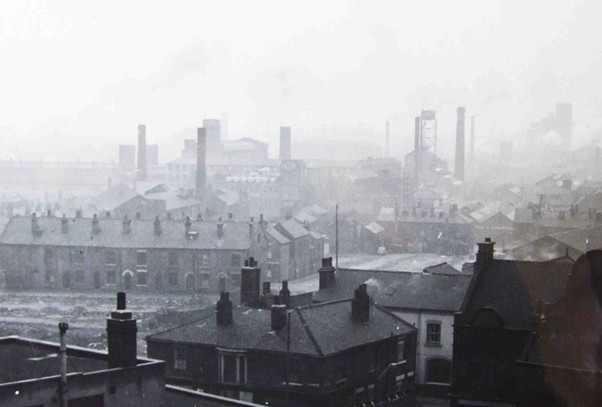
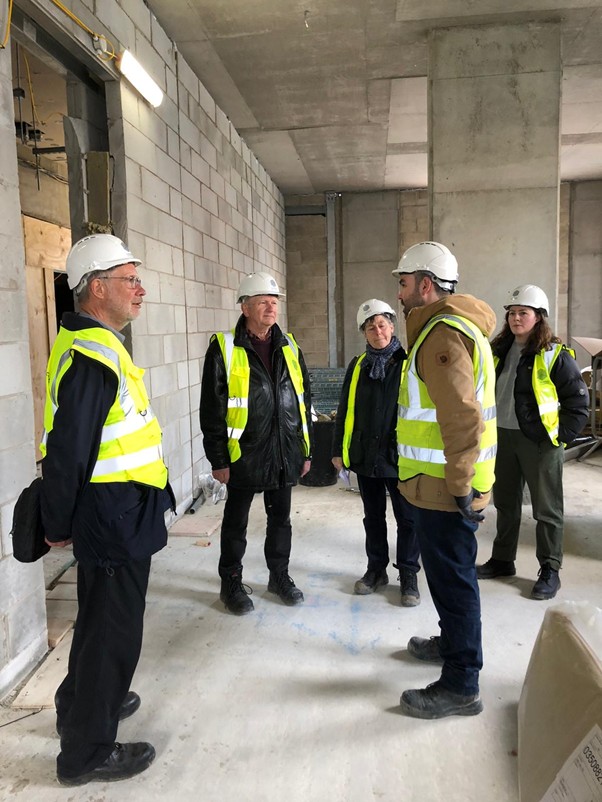
Back in March, members of our Planning Committee and Heritage Watch Group went on a tour of the Dyecoats site on Kirkstall Road, which is being delivered by Latimer (a branch of the Clarion Housing Group). The 13-acre brownfield site was once home to Yorkshire Chemical Works, which operated on the site for over 100 years under the manufacturer Wood & Bedford; the site closed in 2005 and was eventually demolished in 2008. Now, seventeen years later, the redevelopment of the site as a residential scheme is well underway, with eight new high-rise residential buildings set to be built, three of which are well into construction as part of phase 1 of the scheme.
As you walk down from Kirkstall Road, it’s hard to get a sense of how large the site really is. During the tour we were given access to the rooftop of one of the buildings, and from here were able to see how expansive the space is and how impactful the development will be on the landscape once completed. The first three tower blocks will stand at seventeen, fifteen and eleven storeys high, and the scheme will bring together a mix of social housing, shared ownership, and privately-owned apartments.
Over 1,500 residential units will be created from the development, providing very easy walking or cycling access into the city centre. This also includes a new access route over to Otter Island and beyond onto the canal, as a new bridge has also been installed to link to site to its neighbors across the river. The bridge has been installed for some time now, but it will be through these phase 1 works that it will become usable for both residents and the public and will be made accessible for cycling.
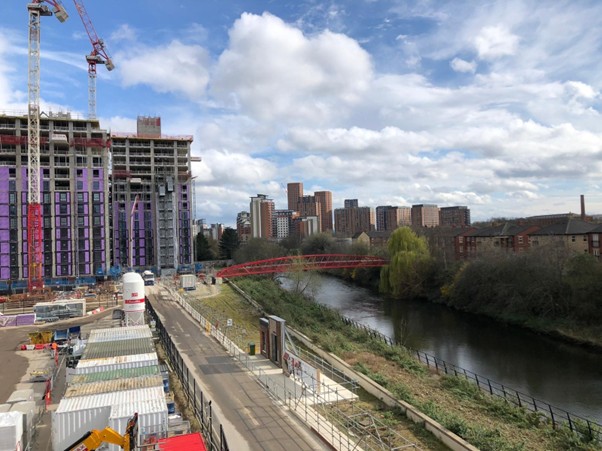
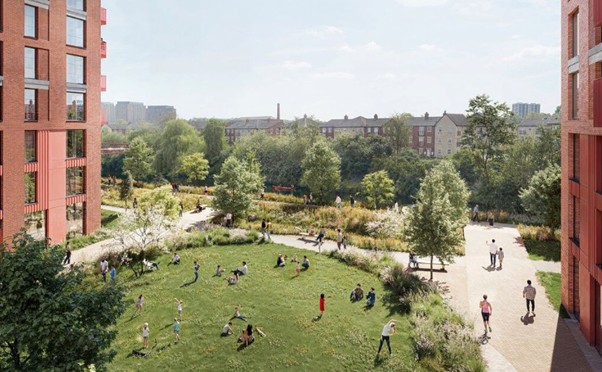
Likewise, work to the riverfront will also be included in this first phase, now making this strip of land accessible to the public. This nice new stretch of the riverfront will hopefully get even bigger with the development next door proposing to create a similar space by the riverfront. It would be nice to see that entire stretch of the river parallel to Kirkstall Road accessible via foot in the future.
A food hall is also set to be built alongside the development. Located roughly in the centre of the site, the food hall will have an array of vendors (similar to Trinity Kitchen) and will be open access. Just minutes from Burley Road the food hall, along with the new access route to the canal, will hopefully capture the interest of the site’s student neighbors. This reflects the hopes of Latimer, who wish to see the site well integrated with its surrounding area.
It was interesting to see the hive of activity on site, and how the buildings are practically put together. We were able to look inside the building which will host social housing units; these were spacious and included good quality bathrooms. Upon the ground floor of the same building, we were shown what could potentially become a commercial space. Paired with landscaping this would nicely cheer up Kirkstall Road.
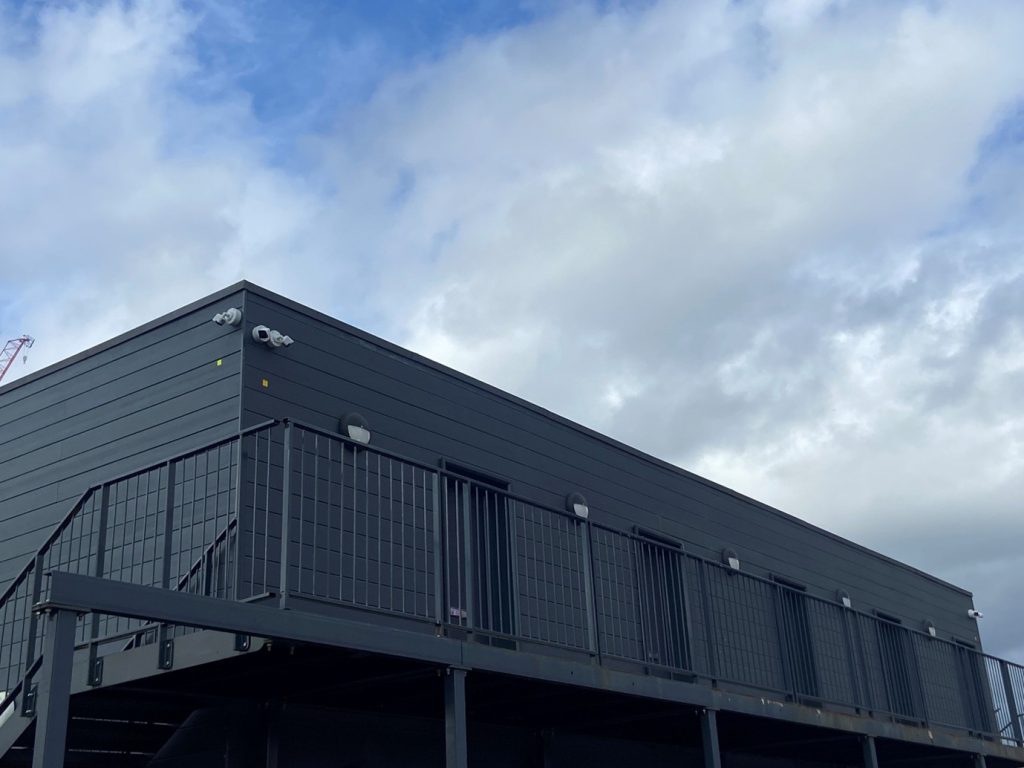
Another addition to the site were nine temporary container-style units. These had been delivered in conjunction with St George’s Crypt and Leeds City Council, to provide shelter for the unhoused. Some of the residents of these units now work on site. This was a thoughtful touch, and one which would be nice to see across more developments in the city.
I am looking forward to seeing how this 10-year project changes this slice of the city. With three of the eight tower blocks already breaking into the skyline, the scheme is one of the more prominent examples of how the city is starting to sprawl outwards.
Alanah Coulson – Planning and Transport Officer