
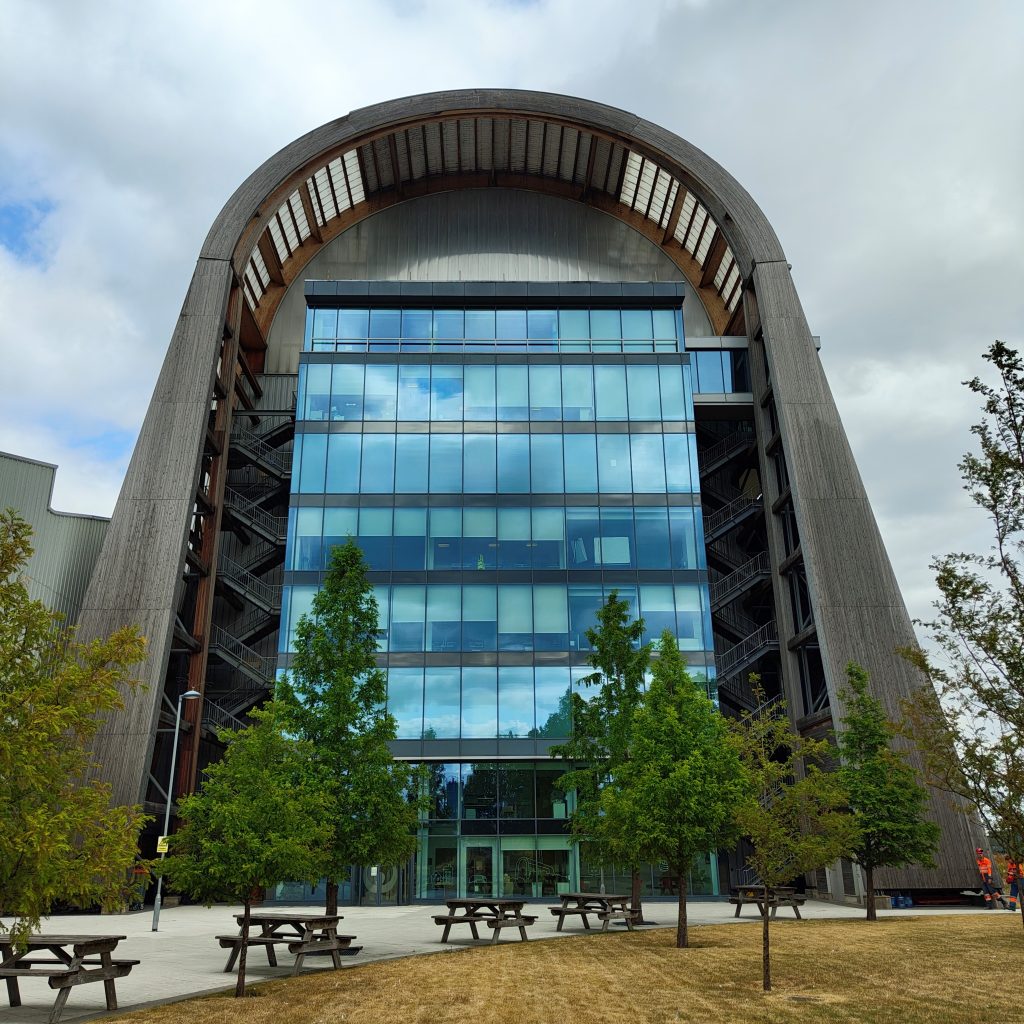
A visit to the Recycling and Energy Recovery Facility (RERF), Cross Green Industrial Estate, Leeds
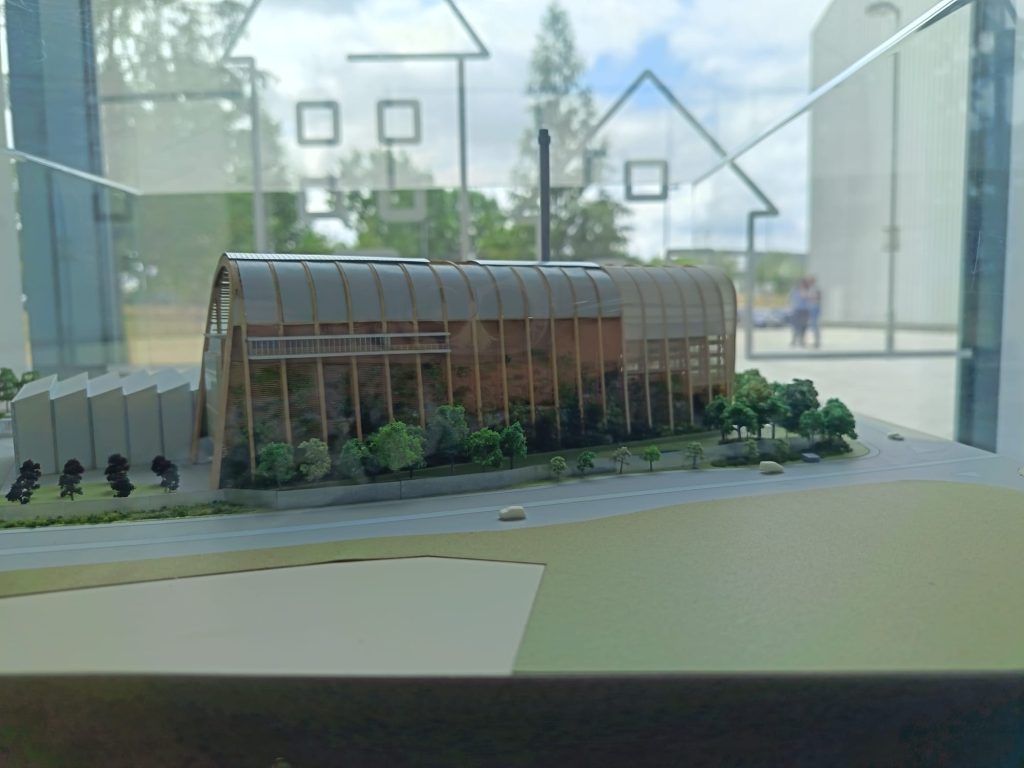
Viewed from the south of Leeds, it looks like a giant moss-covered toaster or a weed-covered airship hangar. As we approached the increasingly imposing facility on foot, we became aware of a smell. Slightly unpleasant, and definitely not mossy toast, more like sweetly rotting fruit. Low key Hitchcock ‘The Birds’ vibes swept over us seeing the vast number of crows around the site entrance, staring at us intently from the wire fences.
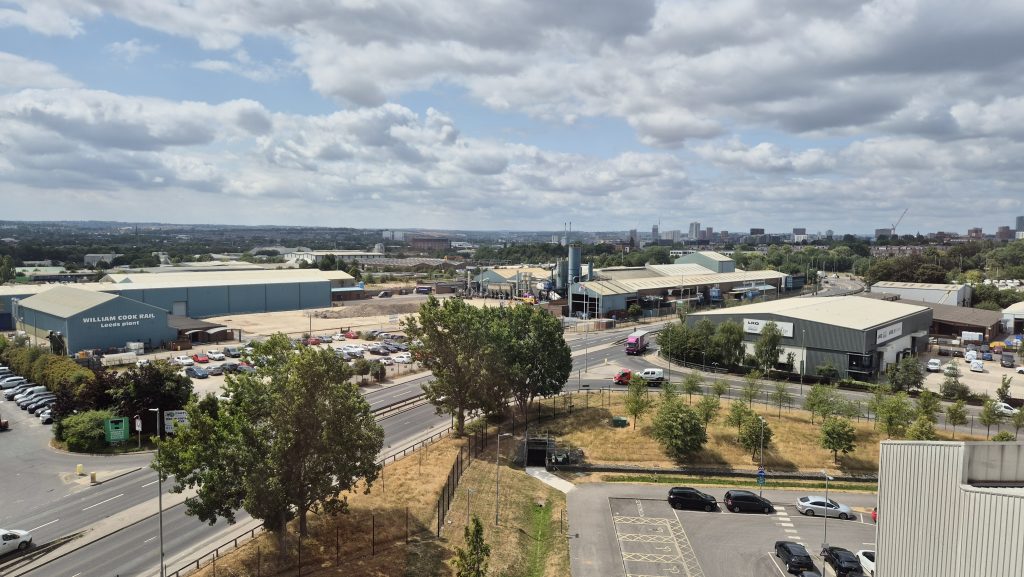
Thankfully the reception area was free of smells & more welcoming than the crows. Once signed in, we’re on our way to the Visitor Centre on the top floor – the only place where photography was permitted. The aroma had returned but immediately forgotten due to the views from the large floor to ceiling windows on opposite sides of the room. To the right, an exhilarating view across the whole of Leeds city centre. To the left was a deep concrete pit filled with the shredded detritus of the city and a massive metal claw grabbing huge piles of rubbish & shaking it in our faces.
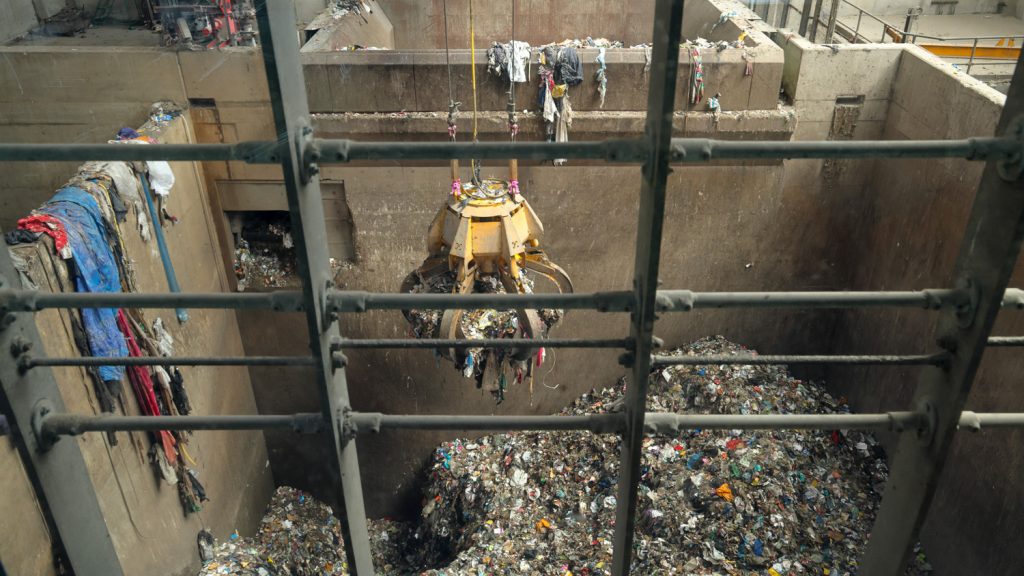
We bounced between the view, getting a little giddy at the huge piles of rubbish & panoramic city view. Then we all had to be quiet & take a seat as our host arrived & took us through the [thankfully short] Health & Safety video & told us all about the site, what it does, how it does it & all that. Rubbish has never been so interesting…
The Recycling and Energy Recovery Facility [RERF] was commissioned in 2016, after construction began in the previous year & has dealt with all the household waste from Leeds. This is part of a 25-year PFI contract between Leeds City Council & Veolia, agreed in 2012. RERF only deals with black bin waste — litter bins & bulky waste are dealt with by other facilities. The site is designed to manage over 200,000 tonnes of rubbish a year, currently handling around 184,000 tonnes, 60% of all household waste, the other 40% is recycled or composted at other sites. Employing 60 staff, the site runs 24 hours a day, 365 days a year.
The architect was Jean-Robert Mazaud of S’pace Architects. He has been instrumental in the development of many rubbish buildings in the UK. Sorry, I meant to say ‘the development of many iconic recycling and waste management buildings in the UK’. Despite its domineering size, the main building is just a timber & glass frame. The design of the building won an award – Project of the Year at the Structural Timber Awards in 2015.
Bin lorries thunder in relentlessly through the crow infested gates & offload their wares, which is pushed about by a big digger for a while before it enters the sorting process. This gives the opportunity to remove bulky items & other things that would damage the sorting mechanisms.
Waste is then shared between two huge shredders, handling 50 tonnes an hour, reducing everything down to a more manageable size. It then goes through a series of processes to remove recyclable materials such as plastics & metal. Ferrous & non-ferrous metals are removed by magnets & electromagnets. All extracted materials are then taken off site for recycling & reuse. Currently 2% of the waste received is saved from incineration & goes offsite.
The remaining waste travels along a conveyor belt, up a slope, then drops into the concrete pit & the giant claw goes to work – grabbing huge clumps of shredded household detritus, shaking it, moving it around & when it is all suitably aerated, it’s lifted high & dropped into another pit further back. The entrance to the furnace….
We get kitted out in full PPE. Stompy boots, hi-vis jackets, big plastic eye protectors & shiny red helmets with yellow ear defenders. They connect to a radio system so our guide can speak to us over the deafening clanking, growling & rumbling inside the building. We clomp down a flight of external stairs & enter the control room. Banks & banks of monitor screen, humming consoles & flashing lights cover one side of the room, the other looks onto the rubbish pit where a man in a big spinny chair welcomes us. The whole site is monitored & managed from here. The giant claw is mostly autonomous, and keeps a steady flow of aerated waste into the furnace, which is visually monitored here via a heat-resistant camera. It looks more like a screensaver on a monitor, but one that is burning between 850°c & 1000°c.
We leave the safety of the control room & venture on into the centre of the facility. This is where it gets real – we are clomping along metal walkways 23m above the concrete floor. Hands on handrails at all times & a little scary if you don’t like heights.
We start way above a long conveyor belt, transporting the waste up to the huge concrete pit & the relentless grabbing claw. Peering cautiously over the handrail we can see some familiar items on the belt, carrier bags from high street shops, a single training shoe, but no fondue sets or cuddly toys.
A little further along, the air temperature rises & we can see a vast array of pipes that carry water around the body of the furnace. The furnace heats these, which turns the water to high pressure steam which drives a turbine and generates up to 11mw [megawatts] of electricity, enough to power 22000 homes. Here though, it powers the entire site & any surplus is pushed back into the National Grid. The only time the site needs external power is after a maintenance shutdown, where they run on a diesel generator until the furnace is up to temperature. The steam is also piped to a District Heating Network which supplies energy to homes and businesses across the city of Leeds.
Gases from the furnace are extracted, filtered & cleaned – particles are separated & stored until they can be removed from site. All that is left is water vapour which can be released through a tall chimney on the roof. Finally, all the ash from the furnace drops down onto another conveyor, is allowed it to cool & transported to a nearby bunker, to be taken away and used in aggregates for road surfaces.
As we loop around the precariously high gantries we finally arrive at a small hatch, the viewing portal into the furnace…it is terrifying & awesome & quite hard to believe that a fire is burning at 1000°c a few feet from your big plastic eye protectors. Our guide was smiling, he knew this was the highlight of the tour and everybody wanted more than one look – the little door needs to be shut every now & again as the heat really starts to come through the thick glass.
We were now approaching the end of the tour & final climb up the metal stairs & around & up & along, higher & higher into the building. We skirt round the huge stainless-steel silos holding the extracted particles from the combustion gases & eventually we walked across one final precipitous walkway & out of a door & into the fresh(ish) air.
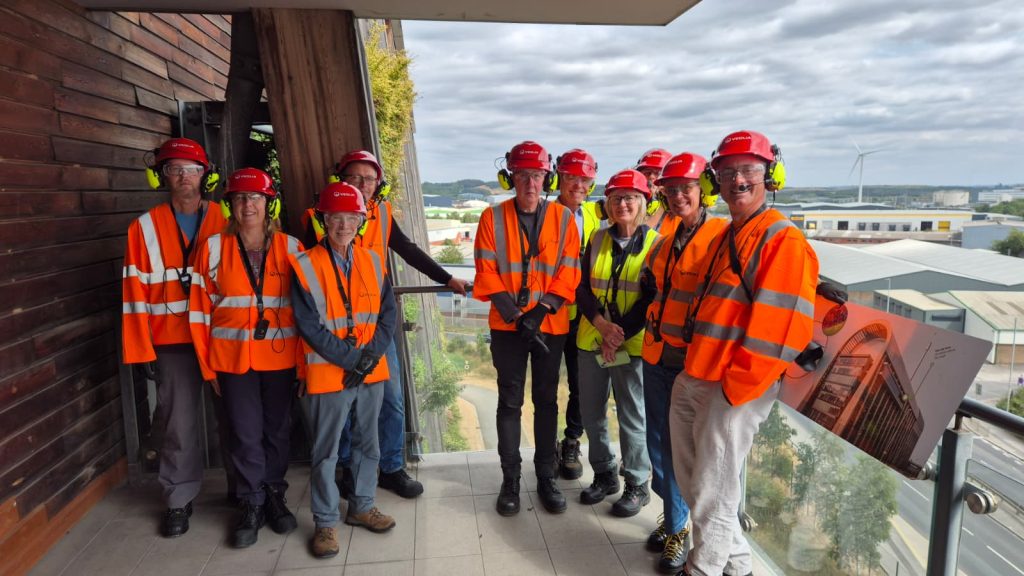
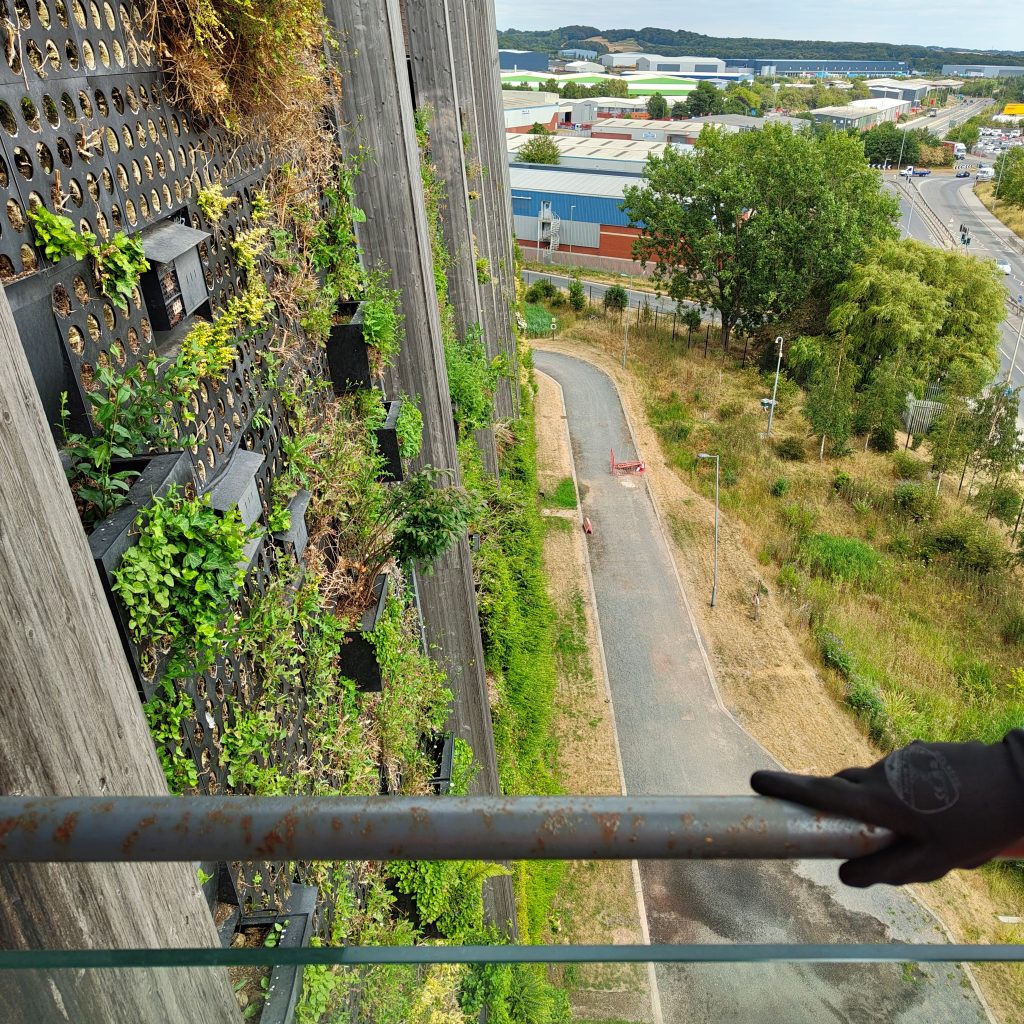
We were on a viewing platform at the top of the green wall and another amazing view across South Leeds & beyond. At 1800 square metres, it is one of the largest in Europe, home to a vast array of plants, grasses, insects & nesting birds, mainly pigeons but also a pair of breeding kestrels. It has suffered in the recent heatwaves & Veolia are in the process of replacing dead plants. All rainwater is collected, stored & used to maintain the biodiversity on display
After a few group photos we were ushered back inside the Visitor Centre, I suspect we took a bit longer than expected on the tour, mesmerised by the flaming inferno at the heart of the facility.
It was an excellent experience, I never expected the processing of rubbish to be so fascinating, and a huge thanks to the Civic Trust staff for organising the trip & escorting us safely around the facility.