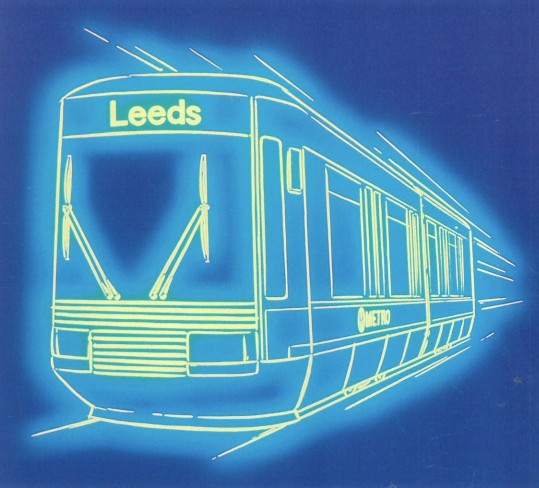
The recent announcement that the first lines in a new West Yorkshire mass transit network may not appear until the late 2030s, several years later than originally planned, has caused great consternation.
Many people look at the 1990s and Supertram in the early 2000s as the starting point for this. However, Leeds’ quest for a mass transit network can be traced even further back, to the aftermath of the Second World War. Everything from an underground to a ‘hanging railway’ has been considered over the decades.
Earlier this year, we published the first edition of our new members’ magazine ‘The Owl’, featuring an article about the decades long quest for mass transit in Leeds. Given the timeliness of this issue, we have reproduced the article here for all to read.
If you enjoy this article, sign up to be a Leeds Civic Trust member to receive our magazine ‘The Owl’ in the post twice a year. Click here to sign up as a member.
Back To The Future: A Tram System for Leeds
The motor car dominates
In 1959, Trams stopped running in Leeds for good, as the city looked forward to a future where the motor car would become an increasingly important mode of transport. This was underlined in the seminal report “Traffic in Towns”, authored by a team led by Professor Colin Buchanan of Imperial College London, that looked at the impact the growth in motor traffic would have on our towns and cities.
The report sought to consider how increased traffic could be accommodated in four locations: Newbury, Norwich, London and Leeds. The proposals for Leeds (central distributor roads and a rather curious hexagonal road pattern), were considered even by them to be impractical.
Co-incidentally, Professor Buchannan was one of the attendees at the inaugural meeting of Leeds Civic Trust in 1965. Unfortunately, our records do not reveal what he said, but it seems doubtful that he would have supported the city’s move to become “The Motorway City of the 70s.”
Road construction may have been de rigueur in the 60s and 70s, but nonetheless Leeds retained a comprehensive bus network in public ownership until deregulation in 1986, an event which may have acted as a catalyst for a number of (failed) attempts to reintroduce trams to Leeds.
Trams, trolley buses and our own Schwebebahn
Leeds historian, artist and long standing Trust member Clifford Stead (who coincidentally is also 60 this year) spoke to the Trust about a subject that has been a lifelong fascination. Through letters to the Yorkshire Evening Post and a meticulously curated archive of leaflets and reports, he has chronicled the ups (and mainly downs) of the city’s quest for a viable mass transit system for much of his adult life. Some of the proposals have been largely forgotten.
For example, in 1985, the West Yorkshire Passenger Transport Executive (WYPTE) proposed the “Electrobus” scheme, a network of overhead-powered trolley buses. The initial line was to go from Roundhay to Cottingley, with a network ultimately expanded to comprise a 76 km network. The ‘Electrobus’ was to be followed by ‘Electroline’, a tram-based system. The schemes never got off the ground due to a lack of government support.
Not to be deterred, the WYPTE, proposed the ‘Metroline’ in 1988. Described as “light rail” this was an attempt to re-introduce a rail based transport system to the city. This project never made it past the drawing board.
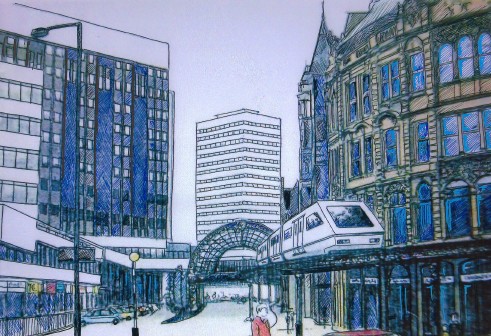
Three years later, Leeds City Council decided to develop its own scheme. Inspired by other schemes overseas (and bearing similarities to the Schwebebahn in Wuppertal, Germany), the proposals included the creation of a network of driverless trains that would convey people above street level. The scheme is largely forgotten and unrecorded, but one image created by consultants Spawforths has survived and has been colourised by Clifford Stead.
Over the course of the next two decades, the Supertram (and then Leeds Supertram) project was developed. It too was cancelled in 2005 due to lack of funds (the government having funded schemes elsewhere in the country), even though it had been given formal government approval four years earlier. This would have seen a tram from Holt Park to Belle Isle. The Headingley leg was the most controversial and led to significant objections organised by local pressure groups.
The final attempt was the Leeds New Generation Transport scheme – another attempt at a trolleybus, which was finally cancelled in 2016.
Prioritising public transport – a rallying call from the Mayor
Since 2014, Leeds has been part of the West Yorkshire Combined Authority, and since 2021, we have had an elected Mayor in Tracy Brabin. These two changes in local democracy together have provided a new impetus to improve the region’s public transport. Bus franchising will be introduced in early 2027, and the Mayor has pledged to deliver for West Yorkshire a tram system with spades in the ground by 2028, when her second term of office is completed.
Leeds Civic Trust has engaged with the process of identifying and developing the initial routes. We produced our own proposals, and even commissioned London-based social enterprise Create Streets to produce some visuals which we hope will set the tone for what we believe should be a public-realm led scheme. With preferred routes due to be published this year, we are hopeful that we may finally see trams returning to the city.
We asked Tracy Brabin to tell us what a new mass transit system will mean for the area:
“It is simple”, she said. The West Yorkshire Tram will be the biggest transport infrastructure project in West Yorkshire since the building of the motorways in the 1960s, and I am thrilled that Leeds Civic Trust has given its backing to the scheme”
“The first phase will see the tram network starting with two routes – one running between Leeds and Bradford, and the other connecting St James’s Hospital with south Leeds. We asked for views on potential route options last year, during which thousands of people from across the region had their say on what they would like to see. We are hoping to go back to the public with more in-depth plans around the turn of next year.
“This is so important to me because I believe people in West Yorkshire should be able to get around as easily as those in places like Manchester, Birmingham, Newcastle and Nottingham, which all have their own tram systems.
“But we also have to believe we deserve it – this is the best opportunity we have ever had to create a region-wide tram network – and now is the time for us to get to work and make it happen.
“The government is supportive of this scheme, but we still need the enthusiastic voices of our residents, businesses, politicians and charities in order to keep the momentum going and make our vision for spades in the ground by 2028 a reality.”
To mark this new dawn, the “Metro” brand, which has been in existence for 50 years, will disappear from bus stops, buses and stations to be replaced by a new name “The Weaver Network.” Poet laureate Simon Armitage has helped to develop this new name, which echoes the textile heritage of West Yorkshire.
So as we look back at the ups and downs of public transport in our city since the Trust was established, there are reasons to be hopeful that Leeds will once again have the public transport system that it deserves.
Martin Hamilton
Director, Leeds Civic Trust
To read our statement on West Yorkshire Mass Transit Delays, click here
If you enjoy this article, sign up to be a Leeds Civic Trust member to receive our magazine ‘The Owl’ in the post twice a year. Click here to sign up as a member.