
The sun shone for our long walk around Thornton, led by volunteer guide Mark Musolf.
Thornton, mentioned in the Domesday Book, was once an isolated village of around 24 houses, described as a puritanical agricultural hamlet. It grew substantially along with its fortunes due to the Industrial Revolution and the rise of textile mills, fireclay extraction and sandstone quarrying.
The consequent rise in the population saw the building of a new church, (St James) replacing what remained of St Leonard’s Church (later to be renamed St James), the Bell Chapel.
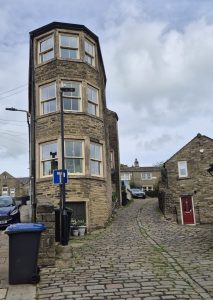
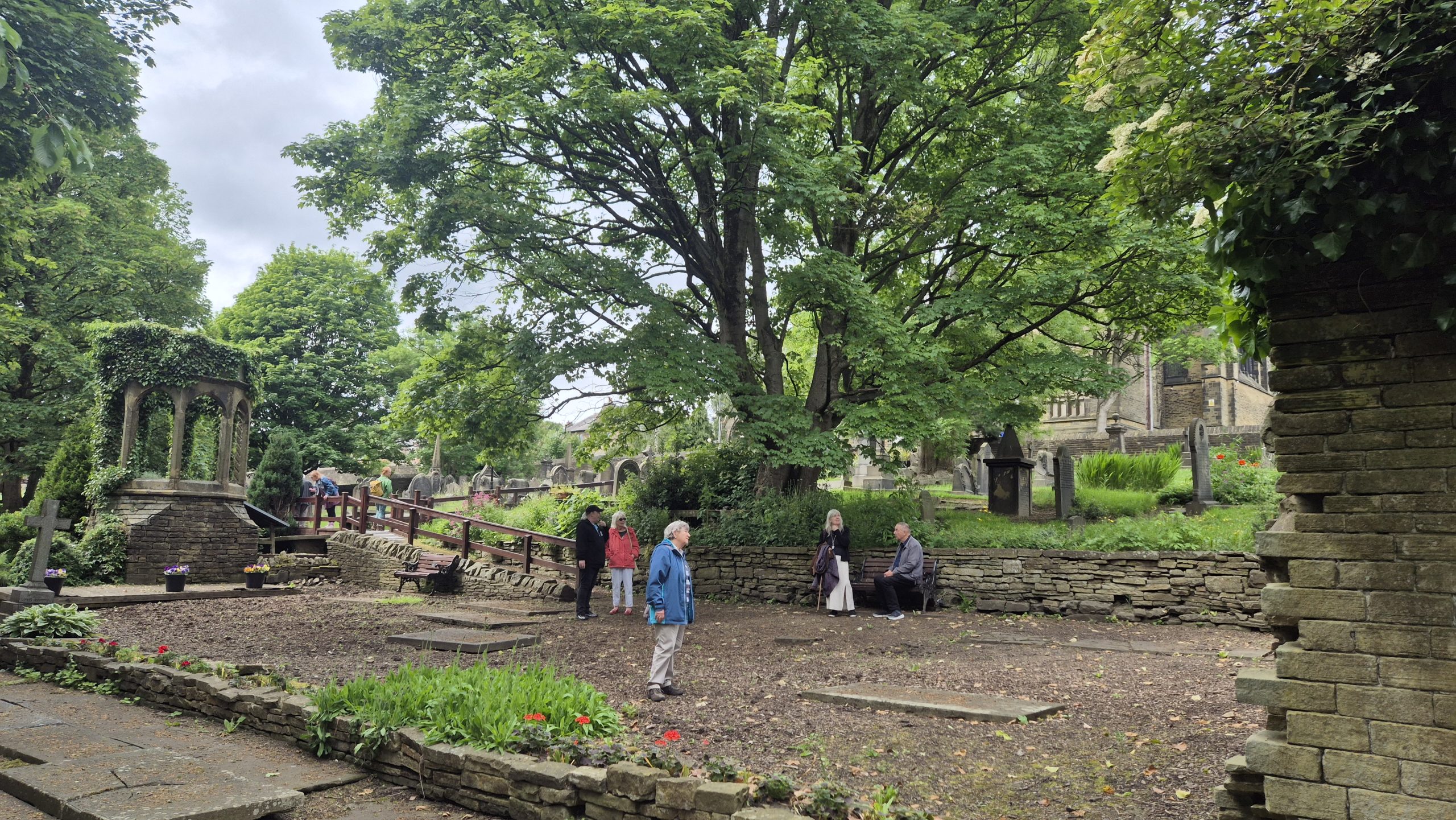
Our walk, from the Birthplace on Market Street to the Bell Chapel and back again, comprised taking in such sites as the ‘Coffin End’ house, ‘Cloggers Row’, the Black Horse Inn, the site of Prospect Mills before it was burned down in November 2015 and the new St James Church.
On Market Street, several properties were designed and built by architects John and Sarah Ashworth so ‘JSA’ can be seen carved in stone above the doorways, including the Birthplace, built in 1802.
Patrick and Maria Bronte arrived in Thornton in 1815 with their six children were baptised at St Leonard’s. Although Patrick described living in Thornton as the happiest time of his life, the family plus two nannies (Sarah and Nancy Garr, aged 12 and 13 years respectively) outgrew this modest property and moved to Haworth in 1820.
The house itself has gone through many changes over the years. Originally a free-standing house, it passed through many hands, with an extension built to the front in the 1890s that now houses the shop and café.
As you climb the steps to the front door, you see on the wall the ‘Charlotte Bronte Stone’. This engraved stone displays a poem by Carol Ann Duffy, Poet Laureate 2009-19, and honours Charlotte’s literary legacy.
In the hallway are the original flagstones, uncovered and restored in the 1990s during the house’s revival. The front room, now called ‘Patrick’s Parlour’ has been sympathetically decorated and furnished to give a sense of what the room would have been like in 1815. The clock that stands by the window is dated 1777, the year Patrick Bronte was born. In display cases are some interesting artefacts that were found during the restoration process. Further along the hallway is the scullery. The domain of the Garrs featuring a cast iron range (not the original but sourced from a pub in Huddersfield!). From the scullery is a stone staircase leading to a nursery where it is thought baby Anne slept (she was only 6 weeks old when the Brontes left for Haworth).
Up the main original wooden staircase, there are three bedrooms. Stepping into the first, Charlotte’s Room, you see a four-poster bed and an original fireplace. It is rumoured that this room was split into two: part was Patrick’s dressing room, the other part was where five, possibly all six children slept.
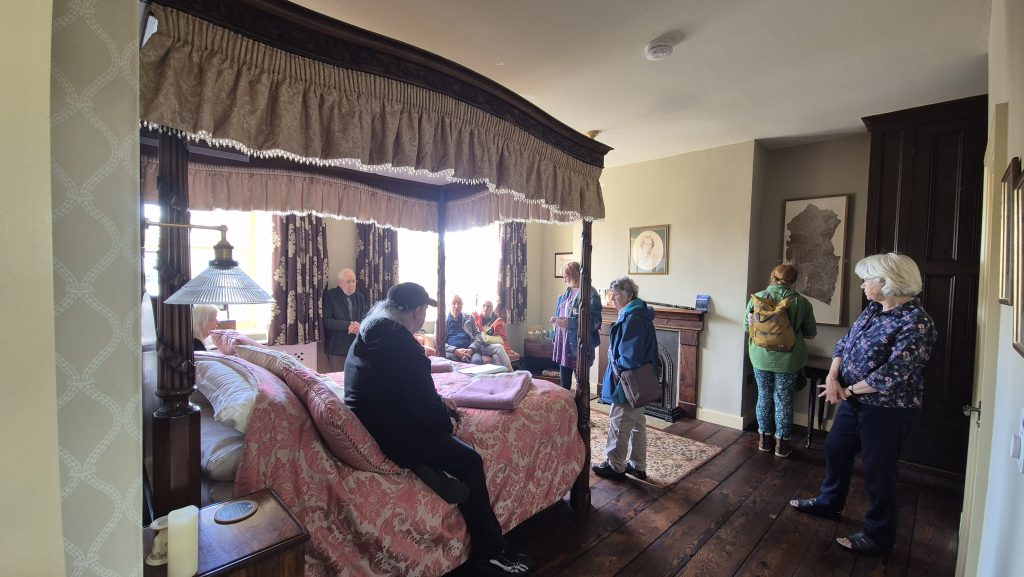
Next was Patrick and Maria’s bedroom: a very basic room that still features the original fireplace.
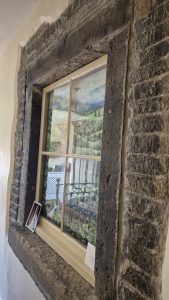
The final bedroom is a smaller bedroom that was not part of the original house but of the nineteenth century extension. Inside the room, there is an internal window. This reveals traces of the original gable end wall with the hand cut stone underneath.
Back downstairs and into what is now the cafe, but was once the living room of the Brontes. Over two centuries, this space has housed an ice cream parlour, a butcher’s shop and a sweet shop. The fireplace is original.
On a beam above the tables is the plaque commemorating the visit by Queen Camilla in May 2025 when she officially opened the newly restored birthplace funded by a successful crowdfunding campaign and grants from Bradford City of Culture 2025 and the Community Ownership Fund.
If you would like to stay and take in the atmosphere, you can! (click here)